

Amazon and Nike took the top two spots among brands winning over American households with teenagers. But they got there in very different ways.
Amazon scored 81.9 out of 100 with teens and 78.5 with their parents. Nike had the opposite profile: 76.4 with teens and 81.0 with parents. Overall, Amazon edged Nike 80.7 to 79.3. One won the teen, the other won the parent, and the two brands finished just 1.4 points apart.
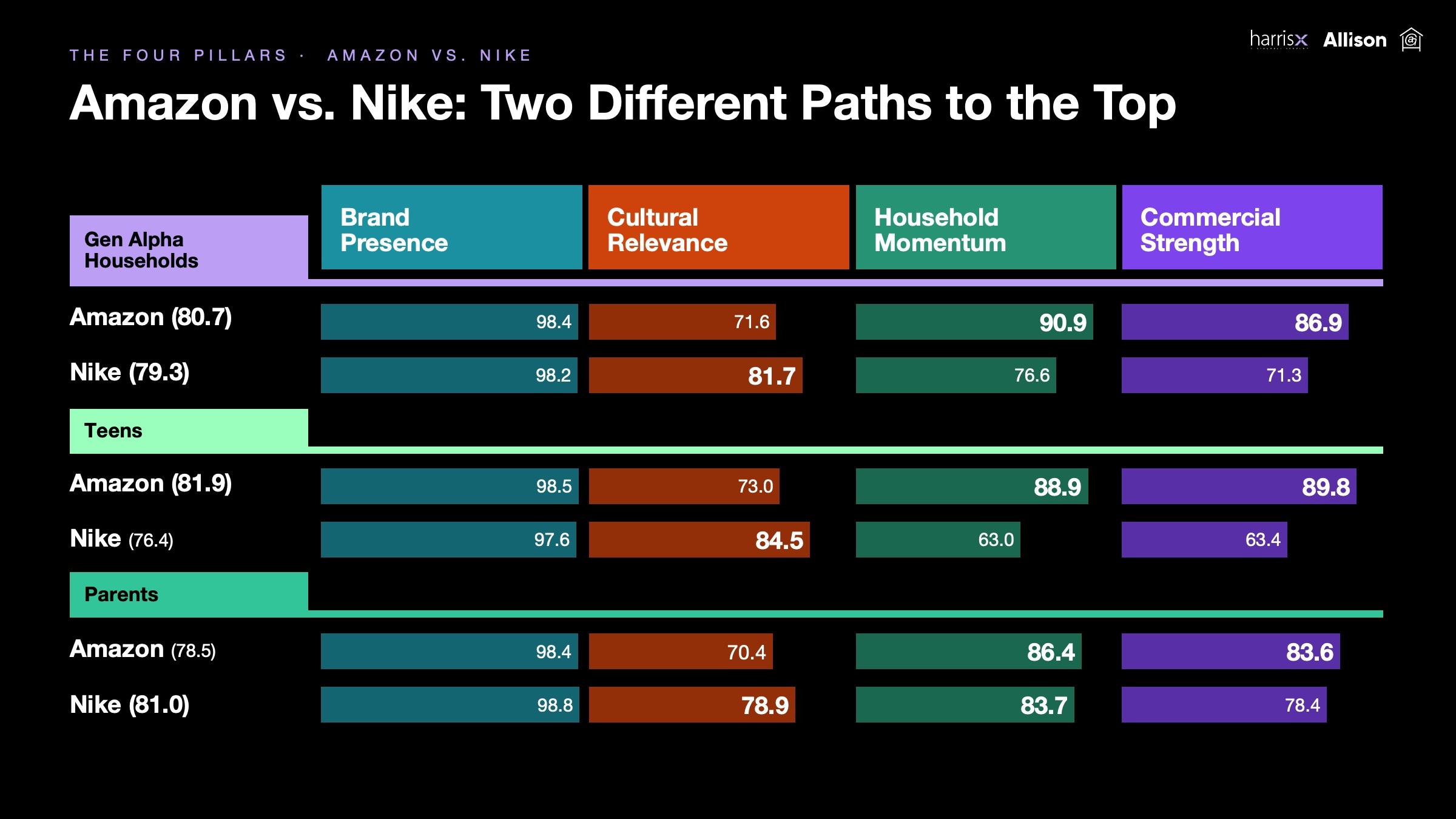
The rankings come from the Gen Alpha Household Influence Study, research from HarrisX and Allison Worldwide covering 1,500 respondents and 25 brands.
What it maps is not a generation but a negotiation.
There is an org chart in the house.
Sixty-two percent of what parents buy for their Gen-Alpha teens starts with the teen asking for the brand by name. With teen girls, it is 67 percent. With teen boys, 59.

“Teen girls aren’t just influential; they’re actually incredibly commercially decisive,” said Anne Colaiacovo, CEO of North America at Allison Worldwide, in a recent interview with Inc. “That’s not just influence; that is actual purchase authority.”
That is a job description. She runs discovery, picks the brand, and makes the pitch. Colaiacovo calls teen girls the CMO of the household, and the numbers hold up the title.
Half of parents say their teen introduced them to a brand they would not have found otherwise. Among dads, it is six in 10.
It runs upward too. Ninety-one percent of parents say their teen shapes which brands the parents themselves like, above what they see in stores and above their own friends.
“It’s no longer that influence simply flows down,” Colaiacovo noted. “It moves in both directions, creating an influence loop.”
Trust left the platforms and moved into the house.
Dritan Nesho, founder and CEO of HarrisX, has a theory about why the people in your customer’s kitchen outrank the creators you pay.
“Influence at the end of the day is about relevance, and it’s about trust,” Nesho said. What his firm keeps measuring is the erosion of it. Confidence in the large platforms is deteriorating, he said, and AI-generated content is accelerating the slide.
People do not stop trusting. They relocate it.
“People tend to retreat, and it’s less about a label, an organization, and it’s much more about an individual whose word you trust,” he added.
For a 14-year-old, that individual is a friend or a parent. For the parent, increasingly, it is the 14-year-old.

Mom is not winning on sentiment. She is winning because the alternatives lost credibility.
The signature is still upstairs.
Then it reaches the person who pays. Roughly four in 10 parents say they do not like a brand their teen really likes, and dads reject at a higher rate than moms. Parents shut down what the teen mentions four out of 10 times, Nesho said, because they hold the power of the purse.
Lululemon shows the cost. Teens named it a favorite, and it finishes 22nd of the 25 brands measured. Winning the kid and losing the parent is not half a win. It is a stalled purchase.

“Gen Alpha teens may drive brand discovery, but mom is deciding which brands earn that actual staying power in the home,” Colaiacovo said.
Her title for that seat is worth borrowing.
“At the end of the day, mom is still that chief household officer,” she added. “She isn’t being replaced by an algorithm.”
The two of them are not in the same room.
Gen-Alpha girls name TikTok as the platform that most shapes which brands they like, followed by Pinterest. Boys say YouTube, then TikTok. Moms say Facebook. Dads say YouTube, then Facebook. Four audiences, four answers, one purchase. Only YouTube clears 50 percent daily reach across all of them.
You can now reach the teen and the parent separately with real precision, which means you can accidentally tell them two different stories about the same brand. The two messages cannot contradict each other, Nesho said.
“Those messages have to dance together well,” he said.
The payoff is two generations for one budget.
Colaiacovo’s case for the harder version is arithmetic. Gen-Alpha sits at the top of the funnel, and the Millennial parent holds the purchasing power. A brand that lands both builds trust with two generations at once instead of renting attention from one.
That is what the ranking shows. Amazon did not beat Nike by winning teenagers harder. It got close enough with the parents. Nike did not win by owning the adult. It stayed credible with the kid.
Most companies pick the loudest end of the table and hope the rest of the house follows.
“Any strategy that misses any half of that is an incomplete strategy,” Nesho said.